Ted's Tidbits
About Archive Photos Replies Reading Tweets Also on Micro.blog
  • August Photo-blogging Challenge, Day 2: Floating

    #mbaug

    → 7:51 PM, Aug 2
  • Up

    #mbaug

    Looking at silly boy upstairs
    → 6:51 PM, Aug 1
  • The 2020 State Fair of Texas Has Been Canceled

    The State Fair of Texas:

    After extensive consideration of the current landscape related to the COVID-19 pandemic and the health and safety of all fairgoers, staff, business partners, and overall community, the State Fair of Texas Board of Directors has voted to cancel the 2020 State Fair of Texas. 

     “This was an extremely tough decision. The health and safety of all involved has remained our top priority throughout the decision-making process,” said Gina Norris, board chair for the State Fair of Texas. “One of the greatest aspects of the Fair is welcoming each and every person who passes through our gates with smiles and open arms. In the current climate of COVID-19, there is no feasible way for the Fair to put proper precautions in place while maintaining the Fair environment you know and love. While we cannot predict what the COVID-19 pandemic will look like in September, the recent surge in positive cases is troubling for all of North Texas. The safest and most responsible decision we could make for all involved at this point in our 134-year history is to take a hiatus for the 2020 season.” 

    I'm not surprised, but seeing the news still makes me sad.

    This won't be the first time in the Fair's 134 years that it's been cancelled.

    The State Fair of Texas has previously canceled Fairs because of World War I (1918), planning for the 1936 Texas Centennial Exposition and 1937 Pan American Exposition at Fair Park (1935 – 1937), and World War II (1942 – 1945). 

    The 2021 State Fair of Texas is scheduled to run Friday, September 24 through Sunday, October 17 in historic Fair Park.

    I look forward to being there.

    [youtu.be/6zPnivuLv...](https://youtu.be/6zPnivuLvaw)
    → 12:54 PM, Jul 7
  • Computer Software and Historic Buildings

    If you want to look at historic homes in Dallas, there are a a few options of places to look. You could visit the Dallas Heritage Village. Located on what used to be Dallas's first city park, the Dallas Heritage Village is a collection of 21 historic buildings that functions as a glimpse of what life used to be like in Dallas in the late 19th century.

    Your other option would be to visit one of Dallas's designated landmark districts. These are neighborhoods protected by ordinances with preservation criteria, specific to each district, administered by the the city's Landmark Commission. These ordinances preserve the homes within the districts by protecting them from willful neglect, demolition, and any renovations that aren't appropriate for the time period.

    Visiting either DHV or a landmark district will be like taking a step back in time. You will get a sense of how things used to be (for better or for worse) and learn a little about our history.

    There is however, one crucial distinction between DHV and a landmark district. While DHV is a collection of actual buildings, it functions as a large outdoor museum. Those buildings exist to educate. Landmark districts, however, are functioning neighborhoods. You can learn some history from these buildings, but they primarily function as homes for families today.

    This distinction influences how these buildings are maintained. DHV's main concern is preserving every historical detail possible with their buildings. Any renovation work needs to be carefully done, so the final product still looks like a preserved historical artifact.

    Homes in landmark districts are, well, … homes. The families that live in them have 21st-century needs and expectations. You can't live in a preserved historical artifact. These building need modern amenities like electricity, plumbing, central air conditioning, and internet access. They need bathrooms, kitchens with modern appliances, etc. Maintaining a home in a landmark district means finding ways to add these modern affordances while still maintaining the original character of the building.

    I am familiar with this because my family lives in a house inside a landmark district, and we are currently renovating the kitchen.

    And while it would be fun to dig into the details of our kitchen project, this is actually a blog post about software.

    For the past several years I have been maintaining a software project called Frontier. I'll save the story of how I came to be doing this for another time. I also hesitate to use the word maintain to describe my actions. Mostly I've been tinkering, reading the source code, learning, and doing the bare minimum to keep it running on modern computers.

    If you read through the source code, you can get a sense of the time of when this application was built. Frontier started it's live as a (classic) Macintosh application. Most of the design decisions in the code seem to be built around the constraints of that computing platform. In the late 1990s it was ported to Windows, and in the early 2000s the application was Carbonized to run natively on Mac OS X. You can see all those layers in the source code.

    Sadly, Frontier doesn't run at all on the latest version of Mac OS X macOS. While software doesn't wear down or rot like physical structures, computing platforms do change, and if the software doesn't change with the platform, it will eventually stop working.

    So I've been thinking about how to approach "restoring" Frontier, and this ties back to the beginning of this post. What is Frontier today? Is it a historical artifact that needs to be preserved "just as it was", or is it a functioning application that caters to the needs of modern computer users?

    If it's the former, then I don't think there's much more to do. Frontier runs fine under emulation. I could put together some documentation for how to emulate a classic Macintosh system that runs an older copy of Frontier. I would keep the source code up on GitHub for people to study and that would be it.

    If it's the latter, then there's a lot of work to do. I basically need to strip the structure down to the studs and begin to rebuild. I would need to find a way to build a modern application that meets the needs of modern computer users while still preserving the "character" of the original application.

    Anyway, these thoughts have been swirling around in my mind lately. Does this comparison make sense to you? Are you familiar with Frontier? If so, which category does it belong in today?

    → 10:50 AM, Jul 1
  • Do Promises Make Your Code Better?

    In a post on GitHub, Dave Winer asks, “What do promises do/make possible that callbacks don’t?"

    This is a great question, and one, IMHO, that is not often addressed or answered well. It often seems that developers embrace new patterns and API, taking for granted that they are better simply because they are newer.

    This question brings me back to when I first had to work in a Promise-heavy codebase. It was five years ago, and I had very similar questions. The answers I got at the time weren’t very convincing. Here’s some sample code that uses the callback pattern:

    request.get('http://api.someurl.com/api/resource', function (error, data) {
      if (error) {
          console.error('An error happened', error);
      }
     
      console.log('Response received:', data);
    });
    

    Now, here’s the same code using the Promise pattern:

    request.get('http://api.someurl.com/api/resource').then(function (data) {
      console.log('Response received:', data);
    }).catch(function (error) {
      console.error('An error happened', error);
    });
    

    It’s different, but is it better? It really doesn’t seem to do anything that couldn’t be done with callbacks.

    Where Promises started to shine for me was when I needed to compose multiple asynchronous responses. I provided code examples on the GitHub thread.

    Dave replied with a link to some code he had written that had some pretty hairy logic involving many levels of nested callbacks.

    I decided to refactor this code to use Promises, and then provide it as an example for further discussion of whether the Promise code is better or not. Along the way, I decided to take it a step further and I used some async functions and generator functions. I recorded my screen while I was making this edits. The finished product is on GitHub, the video is below.

    Let me know what you think. Is this better or just different?

    → 11:01 AM, Jun 29
  • Darth Vader voiced by Frank Costanza

    It is exactly what it says on the tin.

    www.youtube.com/watch

    Delightful.

    → 10:45 AM, Jan 27
  • New Nashville Hot Chicken Restaurant to Takeover Historic East Dallas Landmark

    I’m genuinely excited about this. I remember going to Brinks as a kid. I was sad when it closed, so I think it’s amazing to see a restaurant come into that space after it’s been vacant for so long.

    → 5:46 PM, Jan 8
  • Mike Rhyner, founder of The Ticket and a Dallas radio fixture since the 1970s, is off the air

    It’s the end of an era.

    → 6:08 PM, Jan 6
  • Well, two years after complaining about how I'd made it too difficult to post anything to my blog, I've decided to just move the whole thing back to Wordpress. Hopefully this will be simple enough to encourage me to write more stuff here. We'll see.

    The first order or business is to figure out how to get my archive of posts from the last blog imported into this one. Should be interesting.

    → 11:25 PM, Jan 5
  • I had an idea for a short micro post, went to my Mac to write it.

    20 minutes later, after fixing an issue with rbenv, separating micro-posts from full posts, fixing the build system, etc. I’ve forgotten what I was going to post.

    Perhaps my blogging system is too complex.

    Perhaps I would blog more if there wasn’t so much friction.

    ¯\_(ツ)_/¯

    → 3:53 PM, Feb 12
  • I just added JSON Feed support to my blog.

    • All Posts: http://tidbits.tedchoward.com/feed.json
    • Micro Posts: http://tidbits.tedchoward.com/feed-snippets.json
    → 3:20 PM, May 17
  • That moment when the file format you’ve been trying to re-engineer starts to make sense to you.

    → 2:46 PM, Apr 22
  • Jim Schutze, on the upcomming city council election for Dallas District 14:

    Wood's waffling on the [Trinity River] park plan is concerning, but I'm too embarrassed to offer it here as a serious argument for anything, because that would be just too East Dallas deep-in-the-weeds hillbilly, and nobody outside of District 14 would even get it.

    So let’s say this. The city is on the very verge of a huge change, a generational turnover of power and culture. That’s the hat. District 14 voters will have to make up their minds on that basis. And then we can cut each other’s noses off – that’s the part we really live for anyway.

    → 10:34 AM, Apr 3
  • There seems to be a philosophical disconnect between the two (broadly generalizing) sides of the health care debate. The technical way to frame the debates is this: should health care be an entitlement or not? In other words, should it be something everyone deserves to have provided for them, or should it be something that is sold according to free market rules. I use to be on the free market side of this debate, but I have since shifted to the entitlement side. If I were to distill the reason why I changed my mind, it’s this: When someone dies from a medical condition that could have been treated but wasn’t because they couldn’t afford the treatment, what is your reaction? If it’s, “well maybe that’s not a good thing, but it is fair and just,” then that places you on the free market side of the debate. If, on the other hand, that situation strikes you as unfair and unjust, then you are on the entitlement side.

    → 2:33 PM, Mar 10
  • Lent is a time for discipline, for confession, for honesty, not because God is mean or fault-finding or finger-pointing but because he wants us to know the joy of being cleaned out, ready for all the good things he now has in store.

    -- N. T. Wright, Lent for Everyone: Matthew, Year A (pp. 13-14).

    → 2:50 PM, Mar 5
  • It occurs to me that I’ve been maintaining a micro-blog for years at http://radio3.io/users/tedchoward/. I don’t think of it as a blog, it’s more of a way to share links. It also auto-posts everything to Twitter.

    → 4:20 PM, Mar 2
  • The DMN editorial board is calling out the Republicans in Austin, who claim to be for local control, but instead just want to be the ones in charge. They complain loudly about federal overreach, but then work to take control away from city and county governments. This particular issue, limiting the amount a city or county governement can increase the tax rate, is founded on bad stastics.

    On a side note, I like the new trend of adding a What you can do section to the bottom of their editorials.

    → 3:49 PM, Mar 2
  • L.A. Weekly’s April Wolfe says La La Land is a propaganda film. I didn’t pick up on any of those points when I saw the film. I actually really enjoyed it. I’m now thinking about what that says about me and my perspective. What else am I blind to?

    → 2:03 PM, Mar 2
  • I’m experimenting with “micro” blog posts. Technically they are just regular blog posts without titles. The idea is that they are quick thoughts, not essays. They are the kind of writing that would normally be posted to Twitter or Facebook.

    → 10:13 AM, Mar 2
  • Ten Years Ago

    Ten years ago today:

    • I carried a Samsung flip phone
    • My primary computer was a Windows PC
    • I had a full beard
    • I owed over $50k in debt
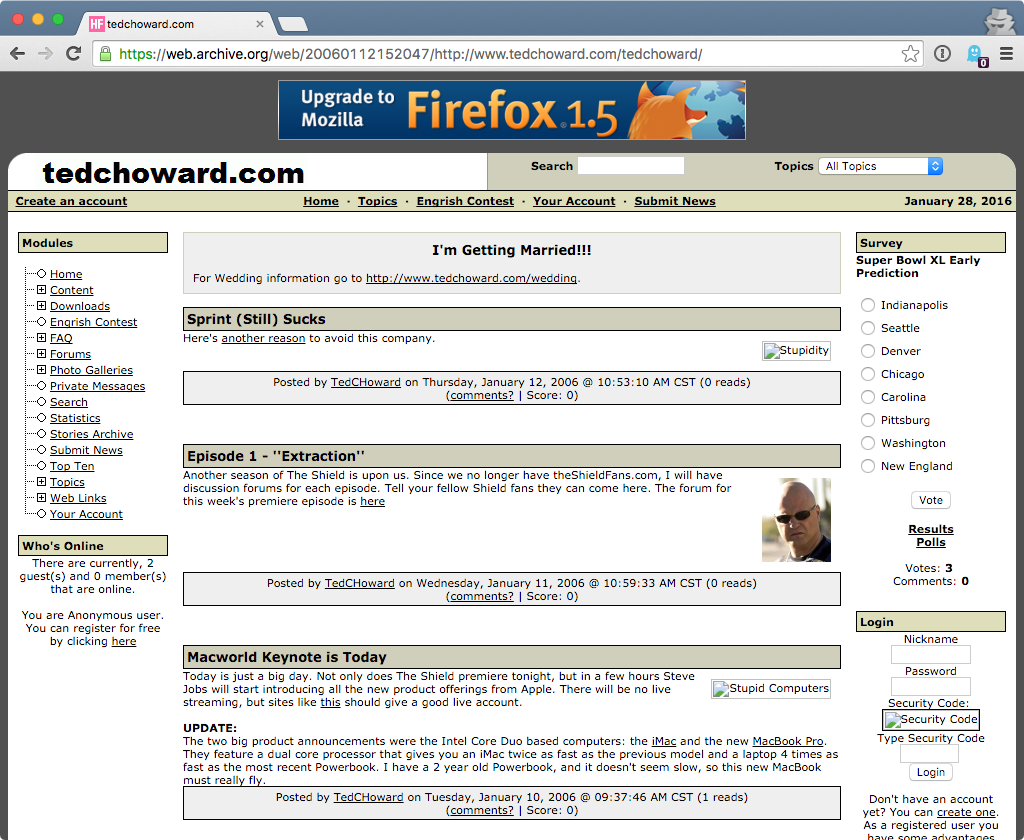
    • My website looked like this: tedchoward.com in 2006
    • I began the day a single man.

    Ten years later, things are unquestionably much better. Yes, I like my iPhone and MacBook, it’s nice to be clean-shaven, it’s wonderful to be debt-free, and my site design skills have improved I still have a website. But the one thing that unquestionably made me into a better person is being married to the woman that, ten years ago, drove me wild.

    Ted and Megan by some flowers in Fair Park

    I met her 21 years ago. I fell in love with her 11 years ago. Over the past ten years, I have learned what it means to truly love someone. Together we have dreamed, we have worked, we have grown. Together we survived graduate school and a startup. With gazelle intensity, we became debt-free and laid the foundation that allowed us to own the home we live in today. Together we wrestled with our faith and what it truly means to follow Jesus in this world. Together we are raising two beautiful boys.

    Ted and Megan reading the Bible in Fair Park

    Looking back, I wouldn’t want to have lived my life with anyone else. Looking forward, I’m still just as excited and thrilled as I was ten years ago at the prospect of spending the rest of my life with her.

    Happy anniversary Megan! I love you.

    Ted and Megan at the Lagoon in Fair Park

    → 9:10 AM, Jan 28
  • Redefining Holiness

    There are many words that Christians use today that I feel have lost their original meanings. Christianity took a common word and used it to explain a uniquely Christian concept. Over time the word fell out of the common vernacular, but the church kept using it. When such words are used today, they come with theological baggage: a specific understanding of the concept is implied whenever the word is used.

    Today, I’d like to talk about the word ‘holy’.

    NOTE: This blog post was adapted from a sermon I preached this past Sunday (May 4, 2014). The sermon was recorded, and that recording is embedded at the bottom of this page.

    As obedient children, do not conform to the evil desires you had when you lived in ignorance. But just as he who called you is holy, so be holy in all you do; for it is written: "Be holy, because I am holy." 1 Peter 1:14-16

    Using the context of the passage above, you might reach the conclusion that to be holy, you must adhere to some moral code (instead of conforming to evil desires). Is this what ‘holy’ actually means?

    Holy Etymology, Batman!

    If we restrict out search to the English language, then, yes, holy has always had a religious definition. Let’s look further. The Hebrew word that is translated to the English ‘holy’ is ‘qadesa’ “which encompasses the idea of separateness and differentiation from the normal."1 It’s first use in scripture is when God is speaking to Moses through the burning bush.

    "Do not come any closer," God said. "Take off your sandals, for the place where you are standing is holy ground." Exodus 3:5

    To be holy is to be different, set apart, special. But the word itself does not specify what makes something holy. It’s just like the word special. If I were to talk about special food, I could be referring to high quality, farm fresh foods, or I could be refering to McDonald’s special sauce. That’s quite a range.

    What Makes One Holy?

    The 1 Peter passage I quoted above says, “… it is written: ‘Be Holy, because I am holy.'” It turns out, the author of 1 Peter is quoting from Leviticus:

    You are to be holy to me because I, the Lord, am holy, and I have set you apart from the nations to be my own. Leviticus 20:26

    Just one paragraph earlier, we read this:

    "Keep all my decrees and laws and follow them, so that the land where I am bringing you to live may not vomit you out. You must not live according to the customs of the nations I am going to drive out before you. Because they did all these things, I abhorred them. But I said to you, 'You will possess their land; I will give it to you as an inheritance, a land flowing with milk and honey.' I am the Lord your God, who has set you apart from the nations." Leviticus 20:22-24

    So, it would appear that keeping the commandments of God is what sets us apart, what makes us Holy. Did I really do all this study2 just to end up with the definition I started with?

    There’s (at least) one more question left to ask:

    Which Commandments?

    The Torah3 contains 613 commandments. The rest of scripture contains countless stories of God’s people failing to keep his commandments.4 Is it reasonable to ask if there are a subset of commandments that we could keep and still maintain our status as holy?

    Hearing that Jesus had silenced the Sadducees, the Pharisees got together. One of them, an expert in the law, tested him with this question: "Teacher, which is the greatest commandment in the Law?" Matthew 22:34-36

    2,000 years ago, someone who was considered an “expert in the law” asked Jesus which commandment was more important than the others. Pay attention to Jesus’ reply. He doesn’t question the premise (that some commandments are more important than others). He doesn’t say that all commands are equal in God’s eyes. Instead, he answers directly:

    Jesus replied: "'Love the Lord your God with all your heart and with all your soul and with all your mind.' This is the first and greatest commandment. And the second is like it: 'Love your neighbor as yourself.' All the Law and the Prophets hang on these two commandments." Matthew 22:37-40

    Jesus is saying that all of scripture is to be understood and interpreted through these two commandments. The most important command is to love: love God and love people.

    If the command is to love, and the thing that sets us apart (makes us holy) is obedience to the commands, then the thing that makes us holy is our love. In programming terms: holiness == love.

    Am I stretching here, perhaps reading too much into the text? After all, if Jesus really meant to redefine holiness as love, wouldn’t he have been more explicit?

    A new command I give you: Love one another. As I have loved you, so you must love one another. By this everyone will know that you are my disciples, if you love one another. John 13:34-35

    In other words, we are set apart as his disciples (made holy) when we love each other as he loved us.

    To be Holy is to Love

    Pause for a second and let your brain re-wire itself: holiness == love_for_each_other.

    Good, now let’s revisit the passage from 1 Peter.

    As obedient children, do not conform to the evil desires you had when you lived in ignorance. But just as he who called you ~~is holy~~ loves you, so ~~be holy~~ love each other in all you do; for it is written: "~~Be holy, because I am holy.~~" "As I have loved you, so you must love one another."

    What are these evil desires? What does it mean to live in ignorance?

    When I see phrases like this, my brain connects them with other phrases like ‘sinful nature’ and ‘flesh’. When the Apostle Paul refers to “desires of the flesh” he often has a list of vices:

    • sexual immorality, imputity, and debauchery
    • idolatry and witchcraft
    • hatred, discord, jealosy, fits of rage, selfish ambition, dissentions, factions, and envy
    • drunkenness, orgies, and the like

    I don’t think this list is what the author of 1 Peter had in mind. He is contrasting ‘evil desires’ with being ‘holy’, which we now know means loving others.

    What are these evil desires? Let me illustrate this with a story:

    It’s 3am. You’re sound asleep. The phone rings. You wake up, and immediately you get an anxious feeling deep in the pit of your stomach. You answer the phone. It’s a collect call.5 You know who it is. You accept the charges.

    It’s your son. He’s in jail. Again. He promised that the last time would be the last time. You believed him because you desperately wanted needed to believe him. What is it this time? Alcohol? Drugs? Is he high now?

    What do you feel? How do you react?

    • Anger: "Do you know what you're doing to this family?!"
    • Guilt: "How could I allow this to happen? I've failed as a father!"
    • Frustration: "That's it! I'm done with him! I can't do this anymore. He can bail himself out of jail, for all I care!"

    Any one of those reactions seems reasonable and justifiable to us, but I would suggest that they are the “evil desires you had when you lived in ignorance.”

    Now that you have purified yourselves by obeying the truth so that you have sincere love for each other, love one another deeply from the heart [from a pure heart]. 1 Peter 1:22

    Loving from a Pure Heart

    What does it mean to have a pure heart? First, a pure heart is not dependent on the behavior or approval of others for happiness or validation. In the story above, the father needs his son to act a certain way in order for him to be happy and feel validated as a father. When the son deviates from the accepted path, the father is incapable of happiness and feels guilt and shame.

    When your happiness is dependent on the behavior of others, it’s impossible to truly love them. Our happiness and validation should come only from God. He created us in his image. He gives us our existance and our purpose. We are loved and valued by God unconditionally. When we can truly believe this, we become able to drop the baggage of co-dependency and truly love others with the love of God.6

    This kind of love is supernatural. You will not be able to just grit your teeth, work harder, and will yourself to love another. The only way to love like this is to drop your baggage at the foot of the cross. Give your life over to Jesus, truly believe that he loves you, that you have a God-given purpose in this life. Only then, through the power of his Holy Spirit, you will be able to truly love as he loved you. You will truly be holy.

    [audio mp3=“https://tedchoward.files.wordpress.com/2014/05/2014-05-04-redefining-holiness.mp3”][/audio]

    Download MP3


    1. Leviticus Primer by Laurent Stouffer (Word doc) ↩
    2. And did you really read this huge blog post (so far) ↩
    3. The first five books in the Bible: Genesis, Exodus, Leviticus, Numbers, and Deuteronomy. Torah is commonly translated to law. ↩
    4. Is one of the 613 the command to be holy? If to be holy, one must keep the commandments of which one is to be holy, we may have our first recorded instance of recursion in human history. ↩
    5. Do they still do collect calls? ↩
    6. For more on this, please read the very excelent Families Where Grace is in Place by Jeff VanVonderen. ↩
    → 9:35 AM, May 9
  • Persecution

    Yesterday, I posted a link to an article by Rachel Held Evans on walking the second mile. It was re-posted by a few people and generated several comments on the different people’s posts.

    One of the themes I saw in the comments was the idea that serving at a gay wedding is equivalent to “bowing to an idol of sin” and that Christians shouldn’t be forced to do so. I spent some time thinking about this. I began to craft a response in the Facebook comments, but I quickly realized that I was writing too many words to be a comment1. I decided to make it a blog post.

    For the sake of this argument, I’ve decided to just take the following assertions at face value2:

    • Gay marriage is sinful.
    • It is a compromise of belief for someone to serve at a gay wedding.
    • Gay couples are targeting Christian wedding service providers by attempting to hire the providers for their weddings and then suing said providers when they refuse service.

    Let’s say all those things are true. Christians being targeted for their beliefs and sued sounds like legitimate religious persecution to me. What should the Christian response be?

    Should we try to change the law to prevent this persecution? Should we hire lawyers and defend our constitutional right in court? Should we take a public stand for our beliefs and “fight back” against the culture?

    Here’s what Jesus has to say:

    Blessed are you when people insult you, persecute you and falsely say all kinds of evil against you because of me. Rejoice and be glad, because great is your reward in heaven, for in the same way they persecuted the prophets who were before you. Matthew 5:11-12

    We’re supposed to be persecuted. If we really believe that serving at a gay wedding is a compromise of our moral beliefs, then we should graciously refuse and then welcome the persecution (e.g. lawsuits) that comes our way without fighting back. Not fighting back probably means settling out of court and paying whatever amount of damages are requested (if not more). Again, Jesus said, …if anyone wants to sue you and take your shirt, hand over your coat as well.3

    We need to remember that those of us who are called to follow Jesus are called to follow him above all other things. We should be Christian primarily and American secondarily. It is very American to want to stand up and defend our rights, but the Christian response is to lay down our lives (the rights go with our lives). The American founders fought their oppressors, our founder told us to love our enemies.

    But God demonstrates his own love for us in this: While we were still sinners, Christ died for us. Romans 5:8

    1. I must confess that I tend to skim over comments that get broken out into paragraphs. ↩
    2. Although there is much that can be debated here. ↩
    3. Matthew 5:40 ↩
    → 12:00 PM, Feb 27
  • The terrorist as rock star

    Dave Winer:

    ...they show us our fear of ourselves. The realization that we equate youthful and sexy appearance with benevolence. Our value system fails. The input does not equal the output. Does not compute.

    Go read the full blog post (it’s not very long). This is a brilliant assessment of both the outrage over the Rolling Stone cover and our misplaced cultural values.

    → 8:12 PM, Jul 17
  • One Grain More

    This is just brilliant. With the new Les Misérables movie, I’ve often thought of resurrecting Les Buffet, but I’m not sure I could best this.

    [youtube youtu.be/k9QbC41oQ…]

    → 10:20 AM, Jan 31
  • Influence

    I don’t like national elections. Don’t get me wrong, I believe in and understand their importance. In fact, I think it’s great that every citizen gets a vote in choosing national leaders. The problem I have with national elections is that it over-inflates the importance of our national leaders. They trick us into putting our hopes and dreams into one candidate. The one candidate who has all the answers for the economy, military, society, etc. It’s easy to get caught up in this contest, even if you try not to.

    It happened to me this year. I didn’t like either candidate. I felt neither one of them represented me, so I checked out. I voted, but did so almost begrudgingly.

    I began to believe the lie that I had no influence in this world.

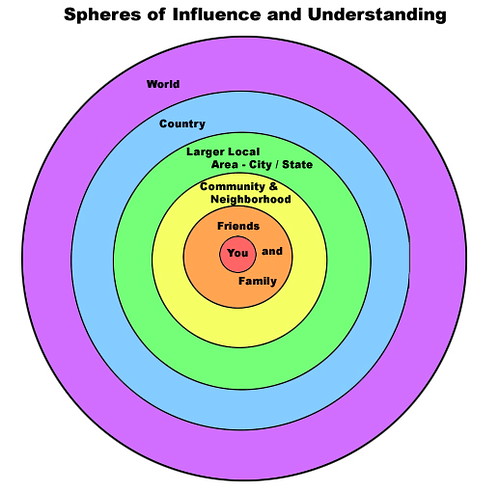
    The truth is, every one of has influence. Influence works like a radio signal. It’s strongest when you’re right next to the tower, and the further away you get, the weaker the signal gets.

    How to Save the World Part I: Spheres of Influence

    I have the most influence on those closest to me: my family, my friends, my coworkers, my neighbors. I have the least influence on those I see or speak with rarely.

    What am I doing with this influence?

    When you believe the lie that you have no influence, you absolve yourself from any responsibility to this world and those around you. Once you accept the truth (that you have influence), you must also accept the responsibility.

    I want to spend some more time unpacking this concept, but first I think we need to live with these questions:

    1. What is the scope of your influence?
    2. What should you do with it?
    → 12:28 PM, Jan 2
← Newer Posts Page 6 of 14 Older Posts →
  • RSS
  • JSON Feed